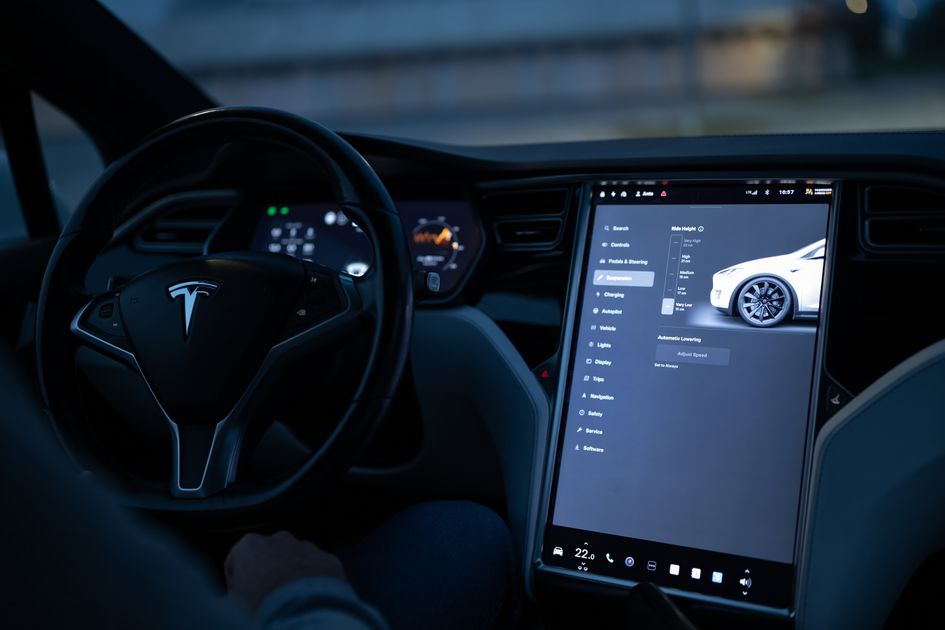
Tesla has officially begun rolling out FSD V14.3.3 — software version 2026.14.6.6 — to a growing group of early access owners starting May 17, 2026. The update introduces a feature that turns one of Full Self-Driving's long-running blind spots into a visible metric: a real-time counter on the center touchscreen tracking exactly how many miles the car has driven since the last human intervention.
Alongside the streak tracker, Tesla is bundling several meaningful changes into the same build: a 33% speed increase for Actually Smart Summon, a restructured disengagement feedback menu, and a backend AI compiler rewrite that claims a 20% improvement in reaction time. The update also ships a new dedicated Self-Driving app — a consolidated hub for subscriptions, usage history, and streak records.
A Streak Counter That Resets on Every Intervention
The most visible change in V14.3.3 is a new widget on the left side of the main screen. It shows the exact distance traveled under Full Self-Driving supervision without a driver takeover — and it resets to zero the moment the driver touches the wheel or disengages. A companion feature inside the new Self-Driving app permanently logs the user's all-time longest intervention-free run.
| Feature | V14.3.2 | V14.3.3 |
|---|---|---|
| Live streak counter | Not available | ✓ On main screen, resets on disengage |
| All-time longest streak | Not tracked | ✓ Logged in Self-Driving App |
| Actually Smart Summon speed | 6 mph | 8 mph (+33%) |
| Disengagement menu options | Preference / Discomfort / Other | Navigation / Parking / Critical / Other |
| AI compiler | Legacy stack | MLIR rewrite, 20% faster reaction |
The design rationale is straightforward: drivers who can see how long FSD has been running without incident are more likely to monitor it attentively, and the feedback loop of watching the counter tick upward creates a data-rich training signal for Tesla's model pipeline.
Actually Smart Summon Reaches 8 mph
Actually Smart Summon — the feature that navigates a parked Tesla autonomously through parking lots to its owner — received a top speed increase from 6 mph to 8 mph in V14.3.3. That is a 33% improvement in maximum speed, bringing the function closer to normal parking lot traffic pace and reducing the time required for longer summon routes.
The improvement also reflects an underlying model merge from V14.3.2: Actually Smart Summon, FSD, and Robotaxi now share a unified AI backbone rather than running on separate neural network branches. A higher confidence in the shared model is likely what made the speed increase viable.
"Driving safely is the most important thing. A streak counter that encourages drivers to hesitate before taking over — even when they should — is a user interface design decision with real safety consequences."
— Chuck Cook, longtime FSD tester and independent evaluator, responding to V14.3.3
Cook's concern is worth flagging: a counter that resets to zero on any takeover creates an implicit incentive to avoid interventions. Tesla's counter-argument would be that FSD has improved to the point where most interventions are genuinely optional — and tracking the streak reveals that to drivers directly. Both claims can be true simultaneously, which is what makes this feature worth watching in real-world data.
Updated Disengagement Menu Improves Training Data Precision
When a driver does take over, V14.3.3 now asks them to categorize the reason using a revised feedback menu. The old options — Preference, Discomfort, and Other — have been replaced with four more operationally specific categories:
- Navigation — driver disagreed with routing or lane choice
- Parking — intervention at the conclusion of a trip
- Critical — safety-relevant takeover; the system was heading toward an error
- Other — catch-all
The new schema is more useful to Tesla's engineering team. Knowing that a takeover was "Critical" versus "Navigation" determines whether the underlying model needs a safety patch or a routing adjustment. Preference and Discomfort produced training signal that was difficult to act on; Critical and Navigation produce targeted improvement directives.
MLIR Rewrite: 20% Faster AI Reaction Time
Beneath the visible features, V14.3.3 includes a significant backend change: Tesla has rewritten its AI compiler using MLIR (Multi-Level Intermediate Representation), a framework originally developed at Google and now maintained by the LLVM project. Tesla's release notes claim the rewrite delivers a 20% improvement in reaction time — meaning the time from sensor input to control output is reduced by roughly one-fifth.
The update also introduces an upgraded reinforcement learning training pipeline and an enhanced neural network vision encoder tuned for low-visibility and rare-scenario driving, including fog, emergency vehicle encounters, and unusual lane markings.
The Bottom Line for Tesla FSD Owners
V14.3.3 is a precise, data-focused update rather than a headline feature release. The streak counter surfaces information FSD was already accumulating but never showing. The summon speed increase reflects measured confidence in the unified model. The MLIR rewrite is infrastructure work that will compound across future releases. The disengagement menu gives Tesla better signal to close gaps faster.
For owners who have been running FSD regularly, the practical day-to-day change is minor. For Tesla's engineering roadmap, the streak counter and categorized disengagement data together represent a meaningful improvement in the quality of feedback flowing back from every active vehicle on public roads.
Photo: Tesla touchscreen / FSD display / Pexels