A sweeping investigation published Wednesday by Reuters has put a spotlight on what the outlet describes as a fundamental flaw in the safety statistics Tesla uses to promote Full Self-Driving. The central finding: a methodological comparison error inflated Tesla's claimed safety advantage by a factor of roughly three, and the company's own former data labelers—the workers who teach the AI how to read the road—say they don't trust it.
The investigation drew on interviews with 9 former Tesla data labelers, 1 former self-driving engineer, and 11 traffic-safety researchers, along with an analysis of Tesla's own published safety figures. What emerged is a picture of a system being marketed on statistics that don't hold up to scrutiny—and a workforce that knows it.
The Comparison That Doesn't Add Up
Tesla's widely cited safety claim—that FSD is up to 10 times safer than human driving—rests on a specific comparison. The company counted crashes where airbags deployed in its own vehicles, then measured that against federal data tracking all crashes requiring a tow truck, a far less severe event threshold. Federal crash data already categorizes airbag-deployment crashes separately, meaning Tesla had access to an apples-to-apples comparison and chose not to use it.
"It's like saying: 'My jet airplane is faster than your World War II bomber.'" — Phil Koopman, Carnegie Mellon University professor of traffic safety
When researchers apply a consistent methodology, the safety advantage drops from the claimed 10x to roughly 3x—and that figure is still clouded by a second structural variable: Tesla's vehicle fleet averages just 4.1 years old, compared to the U.S. national average of 12.8 years. Newer cars have substantially better safety systems regardless of driver assistance technology, making fleet-age-adjusted comparisons essential—and absent from Tesla's reporting.
What the People Who Train FSD Actually Think
Of the nine former data labelers Reuters interviewed, seven said they would not trust FSD to drive them. One was more direct:
"If you fucking paid me, I wouldn't ride in a Tesla robotaxi."
The former self-driving engineer Reuters spoke with described the safety claims as "bullshit" and said they "don't trust Elon on this." Of the 11 traffic-safety researchers who reviewed Tesla's methodology, 10 called it misleading marketing.
| Group Surveyed | Count | Finding |
|---|---|---|
| Former data labelers | 9 | 7 of 9 wouldn't trust FSD to drive them |
| Traffic-safety researchers | 11 | 10 of 11 called the methodology "misleading marketing" |
| Former self-driving engineer | 1 | Called safety data "bullshit" |
On the Ground: Austin One Year In
Tesla launched unsupervised robotaxi service in Austin in mid-2025. Nearly a year later, the fleet operating there consists of roughly 20 vehicles—a number critics note is far below the scale needed to generate statistically meaningful safety data. The service area remains geographically constrained, which the investigation says undermines Tesla's claim that FSD requires "no mapping." Reuters found evidence of intensive pre-launch mapping of Austin routes.
In the six months leading up to the Austin launch, Tesla's Utah data-labeling operation doubled in headcount, growing from approximately 150 to 300 workers. That staffing surge aligns with the scale of human review needed to train autonomous behavior in a limited geographic zone—a labor-intensive process Tesla's marketing does not highlight.
Speed and Safety Incidents
The investigation also surfaced documented FSD behavior that contradicts Tesla's safety narrative. Reviewers found instances of FSD driving 20 to 30 mph above posted speed limits, with one recorded case of the system traveling at 60 mph in a 25-mph zone. Tesla did not issue a formal response to Reuters before publication.
The Bottom Line for Tesla Buyers and Regulators
None of this means FSD is without value—the technology has improved meaningfully since its early versions, and Tesla's scale of real-world miles gives it data advantages competitors can't easily match. But the Reuters findings matter because regulators in California, Texas, and several European jurisdictions are weighing autonomous vehicle approvals partly on safety statistics companies submit themselves. If the methodology underpinning those statistics doesn't survive scrutiny, the approvals may not either.
For current Tesla owners evaluating FSD subscriptions, the investigation is a reminder to treat marketing claims as a starting point, not a conclusion. The people building the system are apparently doing the same.
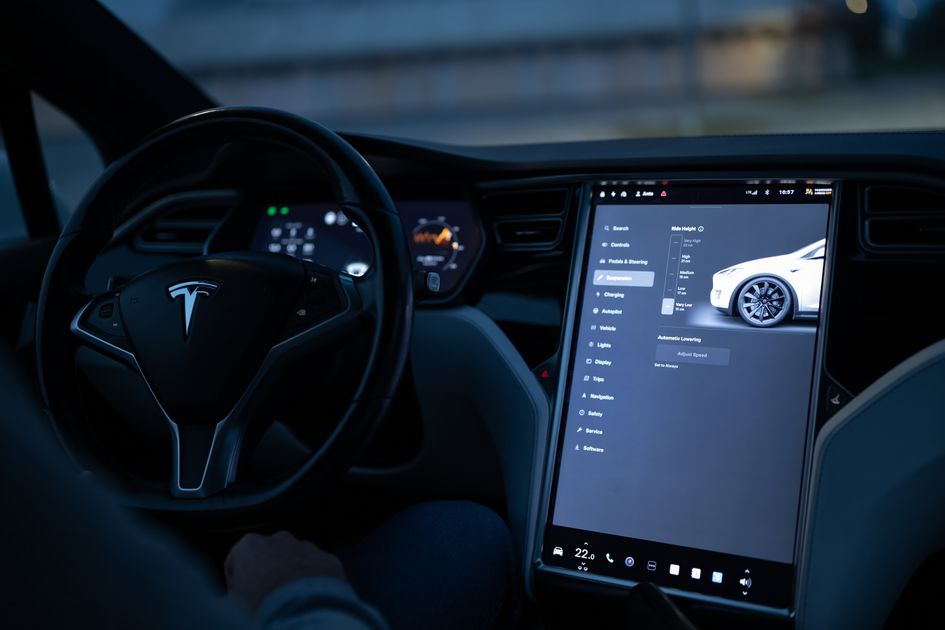
Photo: Tesla touchscreen displaying navigation / Pexels