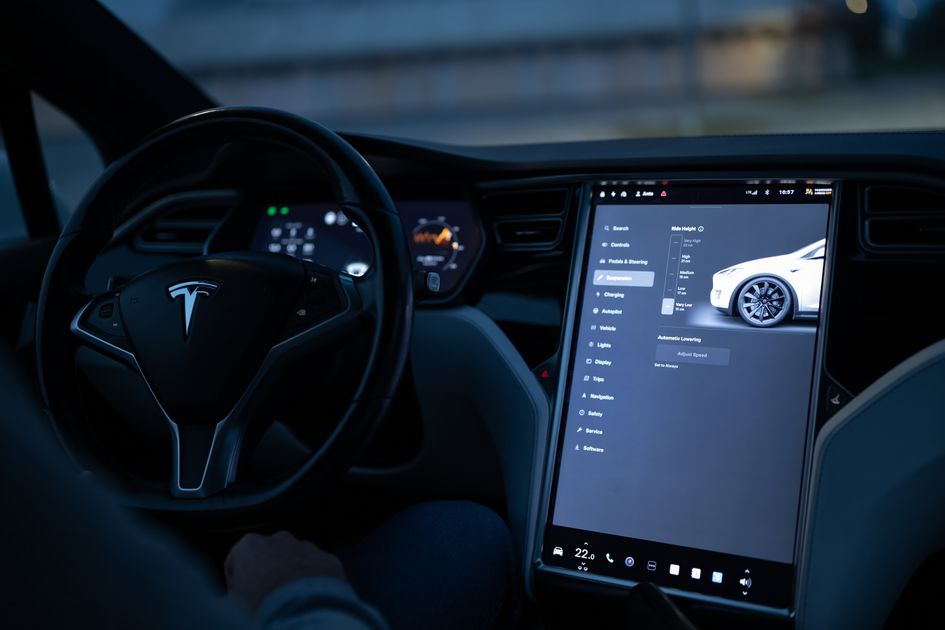
When FSD 14.3.9 began rolling out on September 9, 2026, Tesla crossed a threshold that most automotive safety engineers call "active intervention." For the first time, a production Tesla will automatically steer around an obstacle — not just brake harder — if its neural network concludes that Automatic Emergency Braking alone won't prevent impact.
The feature is called Automatic Collision Evasion (ACE). It is exclusive to vehicles running Hardware 4 (AI4) and requires an active FSD (Supervised) subscription or purchase. On compatible cars, ACE is enabled by default.
What Automatic Collision Evasion Actually Does
Standard AEB applies maximum braking when a collision appears unavoidable. ACE goes further: it activates the full FSD neural network mid-drive and can execute evasive maneuvers — steering into an adjacent lane or onto a shoulder — if the system determines braking alone is insufficient.
According to Tesla's release notes, ACE engages in three specific scenarios:
- Imminent frontal collision — when closing speed makes braking alone futile
- Severe driver inattention — detected by improved eye-gaze tracking, such as reaching toward the back seat or a prolonged eyes-off-road period
- Accidental FSD disengagement — if a driver inadvertently cancels FSD just before a critical situation
During an ACE intervention, the accelerator pedal is ignored entirely. Pressing the brake increases deceleration beyond what ACE alone would apply. Only significant counterforce applied to the steering wheel fully cancels the system's lateral input.
Operating Envelope: What the Numbers Mean
| Parameter | Value |
|---|---|
| Speed range | 22.5 – 85 mph (36 – 137 km/h) |
| Road type | Structured / divided roads |
| Hardware required | HW4 / AI4 only |
| FSD entitlement | Subscription or purchase required |
| Default state | Enabled (cannot be disabled by user) |
The lower bound of 22.5 mph rules out parking-lot speeds where lateral evasion is rarely the right response. The upper cap of 85 mph aligns with highway driving — precisely where high-closing-speed rear-end collisions are most dangerous.
What Else Shipped in FSD 14.3.9
ACE is the headline, but 14.3.9 ships with a meaningful batch of under-the-hood improvements that affect everyday highway driving:
- 20% faster neural network reaction time — achieved by rewriting Tesla's AI compiler using MLIR (Multi-Level Intermediate Representation), a compiler framework now widely adopted in production ML systems
- Small animal detection — reinforcement learning added specific training for objects smaller than a standard vehicle, improving response to animals on the road
- Emergency vehicle and school bus response — improved yield and pull-over behavior when flashing-light vehicles are present
- Parking spot prediction (P icon) — the navigation map now shows a parking-likelihood icon before you arrive, letting drivers plan their approach earlier
- Smart Summon speed increase — maximum summon speed raised to 8 mph (13 km/h)
- Complex traffic light handling — better behavior at intersections with compound signals, curved approaches, and yellow-light edge cases
"Automatic Collision Evasion leverages the full FSD neural network during manual driving and can execute evasive maneuvers such as swerving into an adjacent lane or onto a shoulder if the vehicle determines that braking alone won't prevent an impact."
— Tesla FSD 14.3.9 official release notes, September 2026
What About HW3 Owners?
FSD 14.3.9 is AI4-only. Owners still on Hardware 3 receive FSD 14.1 Lite with this software cycle — a version that retains most highway-driving improvements but excludes ACE and the MLIR-compiler performance gains.
Hardware 3 vehicles shipped on Model S, Model X, and earlier Model 3 / Model Y builds (generally pre-late 2023). To check which hardware your car carries, go to Controls → Software → Additional Vehicle Information. The "Autopilot computer" field will read either "Full Self-Driving computer" (HW3) or "Full Self-Driving computer 4.0" (AI4/HW4).
The Bottom Line for Tesla Owners
Automatic Collision Evasion is the most assertive intervention Tesla has ever shipped to a production vehicle. It is not a comfort feature — it is a last-ditch active safety layer that overrides driver inputs when the neural network concludes the situation is critical enough to warrant it.
For the roughly 1.5 million FSD subscribers Tesla reported entering Q3 2026, ACE is already downloading. AI4 owners who want to verify the feature is active can check Controls → Autopilot → Automatic Collision Evasion after updating to software version 2026.27.5 or later.
Photo: Tesla FSD touchscreen interface / Pexels