Tesla rolled out software version 2026.27.5 on September 6, 2026, and buried inside the update is one of the most significant active-safety additions in the company's history: a feature called Automatic Collision Evasion. For the first time, Full Self-Driving (Supervised) can activate itself while you are driving manually — without you touching a button — when it detects an imminent frontal crash that braking alone cannot prevent.
The update also ships FSD (Supervised) v14.3.9, with a rewritten AI compiler that delivers 20% faster inference on the vehicle's onboard hardware, improved parking-spot prediction, and a unified neural-network model shared across FSD, Actually Smart Summon, and the Cybercab robotaxi fleet.
What Is Automatic Collision Evasion?
Every modern Tesla already has Automatic Emergency Braking (AEB), which slams the brakes when sensors detect an obstacle. Automatic Collision Evasion is what happens when braking is not enough. According to Tesla's official release notes, the system "activates Full Self-Driving (Supervised) to try to keep your vehicle safe and then continue driving" in situations where a collision is imminent and pure braking cannot resolve it.
Once activated, FSD takes full directional control — it can steer into an adjacent lane, onto the shoulder, brake hard, or even briefly accelerate to thread a gap. After the emergency maneuver, the vehicle continues driving under FSD Supervised until the driver resumes control.
"FSD Supervised can now activate on your behalf when an imminent collision is detected and Automatic Emergency Braking (AEB) may not be enough." — Tesla AI team, 2026.27.5 release notes
Three Scenarios That Trigger the Feature
Tesla's release notes describe three distinct situations in which Automatic Collision Evasion can engage:
| Trigger Scenario | What the System Does |
|---|---|
| Frontal collision imminent, braking insufficient | FSD steers, brakes, or accelerates to avoid impact |
| Driver appears inattentive or distracted | FSD activates proactively to maintain safe path |
| FSD unintentionally disengaged by driver | System re-engages to prevent accidental loss of safety envelope |
The second and third scenarios are notable: the car can essentially decide you need help before a crash is literally seconds away. This puts Tesla's active-safety system in the same conceptual territory as Mercedes-Benz's Emergency Assist and GM's Super Cruise attention monitoring, but with the additional ability to steer rather than just stop.
What Else Is New in FSD 14.3.9
Automatic Collision Evasion is the headline, but 2026.27.5 is a substantial release across the board. The full FSD v14.3.9 changelog includes:
| Improvement Area | Detail |
|---|---|
| AI inference speed | 20% faster via rewritten MLIR-based compiler |
| Actually Smart Summon | Max speed raised to 8 mph (13 km/h) |
| Parking prediction | Improved spot selection; available spots shown with P icon on map |
| Emergency vehicle detection | Better response to ambulances, fire trucks, and school buses |
| Animal handling | Enhanced via focused fleet-training data |
| Traffic lights | Improved handling at complex intersections with compound signals and curves |
| Unified model | Single neural net shared across FSD, ASS, and Cybercab robotaxi |
| Lane behavior | Reduced unnecessary lane biasing and tailgating |
The MLIR compiler rewrite is worth underscoring. MLIR (Multi-Level Intermediate Representation) is a compiler framework originally developed at Google and later open-sourced. By rebuilding the inference pipeline on top of it, Tesla can generate hardware-optimized code that extracts more performance from the same AI4 chip without a physical hardware upgrade — a meaningful win for existing owners.
Which Vehicles and Hardware Are Supported
Version 2026.27.5 and FSD v14.3.9 require Hardware 4 (HW4). Supported models are Model S, Model 3, Model X, Model Y, and Cybertruck equipped with HW4. Vehicles still running HW3 continue to receive FSD v14.1 Lite, which does not include Automatic Collision Evasion.
Tesla has not specified a timeline for backporting the collision-evasion feature to HW3, and given the 20%-faster MLIR optimization is hardware-specific, a straight port is unlikely in the near term.
The Bottom Line for Tesla Owners
Automatic Collision Evasion represents a meaningful philosophical shift: your Tesla can now decide to take the wheel without being asked. For most owners, that is exactly what you want in the half-second before a crash — an AI that acts faster than reflex. The 20% inference speed-up means those decisions happen even quicker than before.
If your car shipped with HW4, the update should arrive over the air automatically. Check Controls > Software to confirm you're on 2026.27.5 or later, and review the new Automatic Collision Evasion settings in the Safety menu before your next drive.
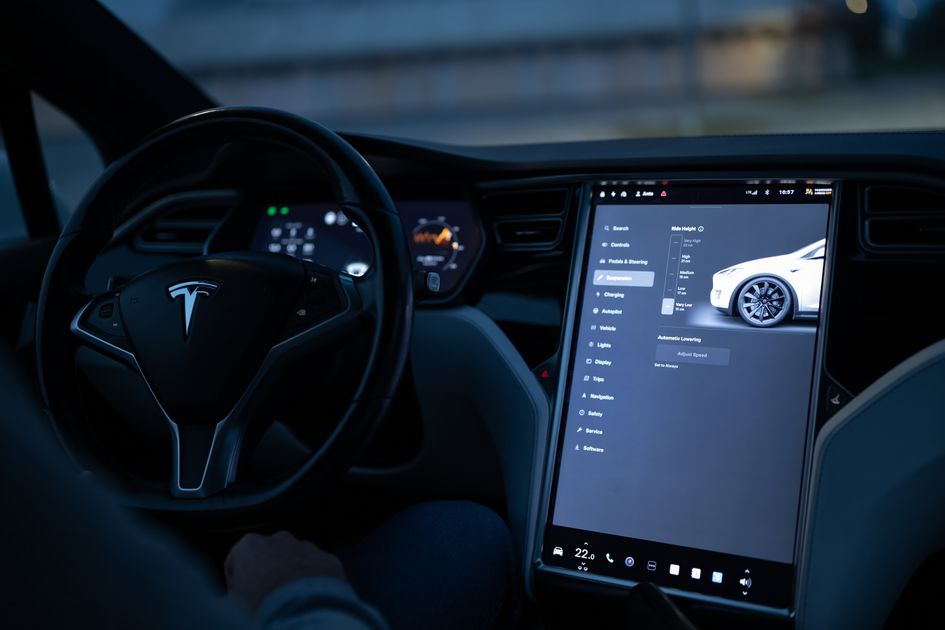
Photo: Tesla touchscreen FSD interface / Pexels