Tesla pushed software version 2026.26.6.5 to owners on August 26, 2026, pairing it with two FSD builds: FSD Supervised v14.3.8 for HW4 vehicles and FSD Supervised v14.1 Lite for HW3 vehicles. The headline changes center on a rebuilt neural network vision encoder, reinforcement-learning upgrades across a wide range of driving scenarios, and meaningfully better handling of emergency vehicles and school buses.
What's New in FSD 14.3.8
Tesla describes the vision encoder upgrade as improving three distinct capabilities: understanding in rare and low-visibility scenarios, strengthening 3D geometry reasoning, and expanding traffic-sign comprehension. Those aren't abstractions — they map directly to real-world moments: cresting a hill into direct sunset glare, reading a partially obscured stop sign, or parsing the exact position of a cyclist at a complex intersection.
On the reinforcement-learning side, the training stage was upgraded to produce improvements across a wide variety of driving scenarios. Emergency vehicle response, school-bus handling, and rare-object detection each received targeted fixes in this build.
| Improvement Area | Detail | Status in 14.3.8 |
|---|---|---|
| Neural network vision encoder | Low-visibility, 3D geometry, traffic signs | Upgraded |
| Reinforcement Learning stage | Broad driving-scenario coverage | Upgraded |
| Emergency vehicle response | Yielding, lane-clearing behavior | Improved |
| School bus detection | Stop-arm recognition, zone awareness | Improved |
| Rare object detection | Construction debris, unusual vehicles | Improved |
| Lane biasing / tailgating | Unnecessary lateral drift and close following | Mitigated |
| Parking spot decisiveness | Selecting and executing into tight spaces | Increased |
| Parking location pin | Predicted arrival spot shown on map with P icon | New |
MLIR Compiler and 20% Faster Reaction Time
Earlier in the v14.3.x cycle, Tesla rewrote its AI compiler and runtime from the ground up using MLIR (Multi-Level Intermediate Representation), delivering a 20% faster reaction time. FSD 14.3.8 continues to run on this compiler infrastructure, meaning every subsequent neural network improvement lands with that same speed advantage baked in. The practical effect: the system responds to a pedestrian stepping off a curb, or a parking gate beginning to close, measurably faster than pre-MLIR builds.
"Rewrote the AI compiler and runtime from the ground up with MLIR, resulting in 20% faster reaction time and improving model iteration speed." — Tesla 2026.26.6.5 release notes
Actually Smart Summon Now at 8 mph
Also bundled in this release: Actually Smart Summon's top speed is now 8 mph (13 km/h), a 33% increase from the previous 6 mph ceiling. Smart Summon navigates your Tesla across a parking lot to find you without a driver behind the wheel. The speed bump is subtle in isolation, but in a sprawling mall lot it meaningfully cuts the time you spend waiting at the curb — and signals Tesla's growing confidence in the system's obstacle avoidance at slightly higher speeds.
HW3 Owners Get FSD 14.1 Lite
Owners of older HW3 vehicles — roughly the Model 3 and Model Y built before late 2022 — continue to receive their own FSD track with this update. FSD Supervised v14.1 Lite brings:
- Parking, unparking, and reversing improvements under FSD control
- Arrival Options: choose your preferred parking spot from a map before the car commits
- SLOTH speed profile: even more conservative speeds and lane selection than CHILL, for owners who prefer a very relaxed driving style
- Fewer false slowdowns and smoother steering inputs throughout the journey
HW3 owners won't get the full neural network upgrades in 14.3.8 — compute limits prevent a direct port — but the Lite track has been narrowing that gap with each release.
New Transparency: Intervention Tracking
FSD 14.3.8 also adds a small but meaningful transparency feature: owners can now log the reason for each disengagement and track cumulative intervention distance metrics directly in the app. It's a nod to users who genuinely want to understand how FSD is performing on their specific commute — and to Tesla, which uses this aggregate data to prioritize training improvements.
The Bottom Line for Tesla Owners
Version 2026.26.6.5 is the Summer Update reaching its most complete form: a proven MLIR foundation, a smarter vision stack, and a long list of behavioral polish in the areas that matter most to everyday drivers — emergency vehicles, school zones, and the last hundred yards of parking. If your vehicle is showing the update notification, the case for installing it quickly is straightforward.
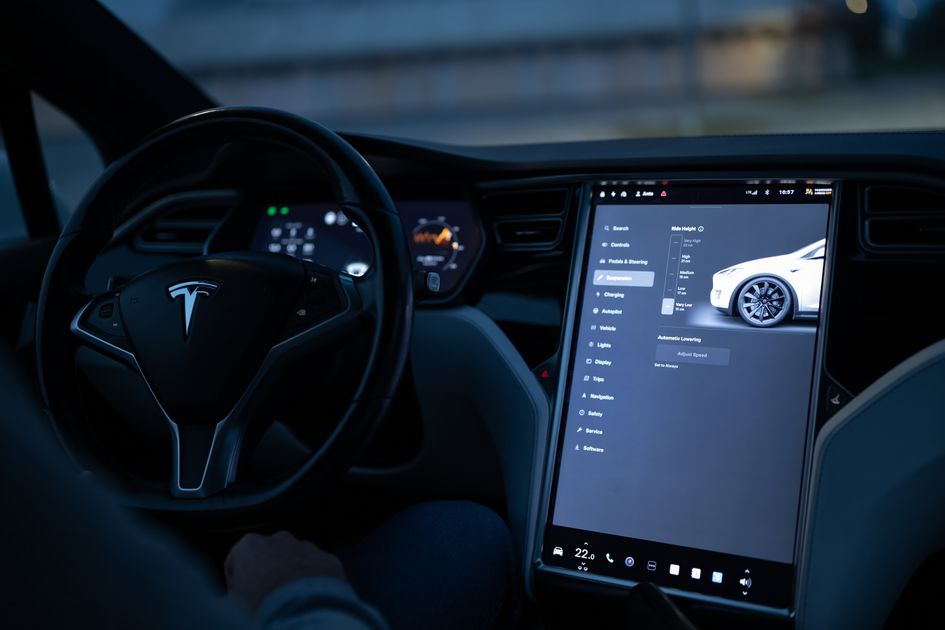
Photo: Tesla touchscreen and FSD visualization / Pexels