Tesla quietly pushed software update 2026.38.5.10 to HW4 vehicles on October 20, 2026 — and buried inside the familiar Halloween Mode changelog was a change with long-term consequences: the neural network running FSD 14.3.13 is now the same model powering Summon and Robotaxi. Every time you tap Summon in a parking lot, your car is running the same AI brain Tesla deploys in its paid robotaxi service.
That is not a marketing claim. It is a deliberate architecture decision — and the version history tells the story. When FSD 14.3 first shipped in April 2026, Tesla rewrote its AI compiler from scratch using MLIR (Multi-Level Intermediate Representation), the compiler infrastructure created by Chris Lattner, formerly VP of Autopilot Software at Tesla. The rewrite delivered a claimed 20% faster reaction time. Version 14.3.13, shipping now, extends that same foundation — and unifies the model across three previously separate driving programs.
One Brain, Three Jobs
Before 14.3, Tesla maintained distinct neural network branches for Summon (the short-range parking mover), FSD (highway and city street navigation), and its Robotaxi stack. That separation made sense during development — different safety envelopes, different training data, different compute budgets. But it also meant improvements in one branch did not automatically flow to the others.
The unified model in 14.3.13 changes that. A single set of weights handles parking lot navigation, full-speed city driving, and the driverless Robotaxi operating envelope. For owners, the practical benefit is immediate: Summon now inherits 14.3.13's improvements in parking spot selection, reverse path planning, and small obstacle avoidance — features that previously only reached FSD drivers.
“Rewritten from the ground up with MLIR, delivering 20% faster reaction time and improving model iteration speed.” — Tesla 2026.38.5.10 release notes, October 20, 2026
What Changed in 14.3.13
The full feature list in the October 20 release notes covers eight areas of improvement over the previous 14.3.12 build:
| Area | What Improved |
|---|---|
| Reaction time | 20% faster via MLIR-based AI compiler and runtime rewrite |
| Vision encoder | Upgraded for rare and low-visibility scenarios; stronger 3D geometry understanding |
| RL training | Enhanced reinforcement learning stage across a wider variety of driving scenarios |
| Parking | Better parking spot selection and location pin prediction |
| Emergency vehicles | Improved detection and response to emergency vehicles and school buses |
| Small obstacles | Enhanced handling of small animals and low-profile road debris |
| Intersections | Better traffic light management at complex multi-lane intersections |
| Driver monitoring | Improved eye-gaze tracking for driver attention detection |
Of these, the vision encoder upgrade is the most consequential for everyday driving. FSD's previous encoder was optimized for common road scenarios — sunny days, clear lane markings, familiar intersection geometries. The updated encoder specifically targets rare scenarios: construction zones at dusk, unmarked rural intersections, faded crosswalks in rain. Those edge cases are exactly where earlier FSD versions showed the most hesitation.
Which Hardware Gets What
FSD 14.3.13 is exclusive to HW4 vehicles. If your car has the Hardware 4 compute platform — introduced with the refreshed Model 3 in late 2023 and standard on Cybertruck — this full update is coming to you. Older HW3 cars (pre-refresh Model S, 3, X, Y) receive a separate build called FSD 14.3 Lite.
| Version | Hardware | Models |
|---|---|---|
| FSD 14.3.13 (full) | HW4 | New Model S, New Model 3, New Model X, Model Y, Cybertruck |
| FSD 14.3 Lite | HW3 | Model S, Model 3, Model X, Model Y (pre-refresh) |
What HW3 Owners Get With 14.3 Lite
FSD 14.3 Lite is not a stripped-down consolation prize. Tesla describes it as a distilled version of the HW4 intelligence — the same architecture compressed to run within HW3's compute envelope. The October update brings HW3 owners three features they have never had before:
- Parking and unparking via FSD — Summon-style behavior now integrated into the FSD flow
- Reversing with FSD active — the car can now back out of driveways and tight spots without disengaging
- SLOTH speed profile — a new option even more conservative than CHILL, for school zones and crowded parking structures
For HW3 owners who bought FSD years ago and have been watching HW4 owners pull ahead in capability, this update closes a meaningful portion of the gap.
The Bottom Line for Tesla Owners
The most important thing about 14.3.13 is not any single feature — it is the architecture underneath. A unified model across Summon, FSD, and Robotaxi means Tesla's entire self-driving stack is now iterating as one system. Improvements made for Robotaxi operations flow directly to your parked car's ability to navigate a tight garage. Improvements made for FSD highway merges inform how Summon threads between parked cars.
If you are on HW4, update 2026.38.5.10 is already rolling out. Check Software in your Tesla app to see if you are in the first wave. Rollout statistics from Teslascope and Not a Tesla App show fewer than 0.2% of the fleet had the update as of October 20 — full rollout typically completes within two to three weeks of initial release.
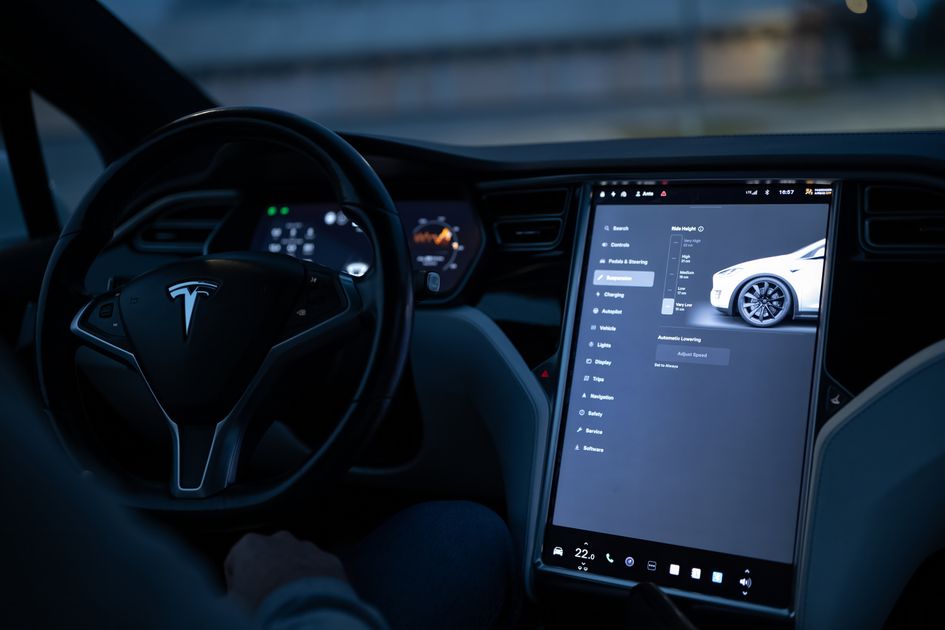
Photo: Tesla touchscreen and FSD interface / Pexels