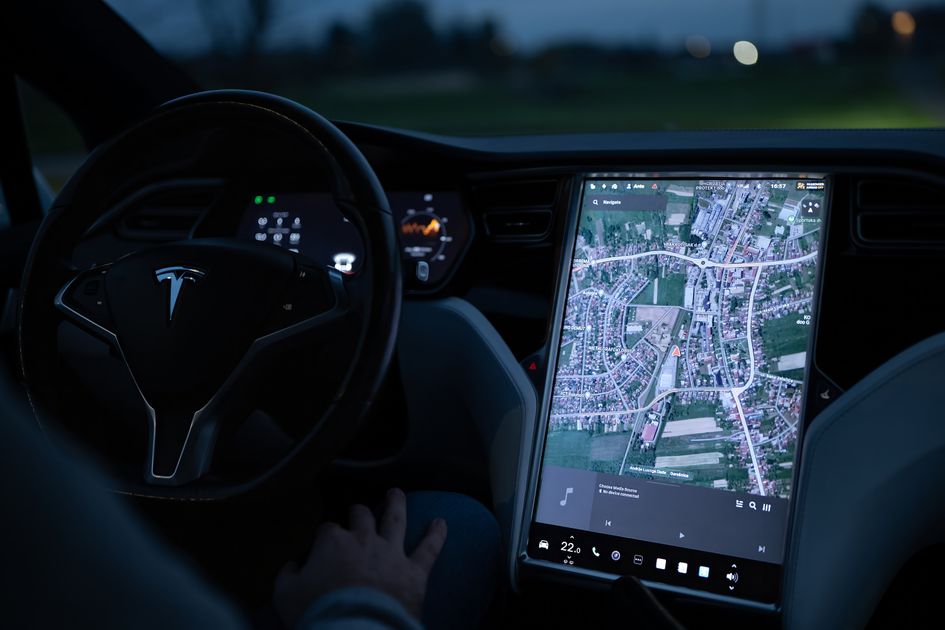
On May 28, 2026, Elon Musk posted a video to X that captured something genuinely new: a production Tesla Cybercab rolling off the factory floor at Gigafactory Texas with no one in it, no steering wheel to grip, and no pedals to press. The gold-finish vehicle drove itself out of the facility entirely under its own control — a demonstration that the hardware and software are far enough along that the vehicle can navigate a real production environment without any human hand on anything.
The clip was brief, but the signal it sent was clear. Tesla's AI Director Ashok Elluswamy followed the post with a statement on X confirming that vehicles like this one would "soon be driving themselves straight into Austin to begin robotaxi service." Senior AI team member Yun-Ta Tsai also marked the moment publicly, a sign of how much the team regarded this exit from the production line as a milestone worth noting.
What Makes This Different from Previous Cybercab Footage
Tesla has been showing Cybercab prototypes and test units for months. What changed on May 28 was the context: this was a production-spec vehicle, built at the Giga Texas line that has been ramping since April 2026, driving itself through the facility's outbound logistics area. It wasn't a controlled test track, a curated media demonstration, or a closed-course display.
The Cybercab has no steering wheel and no brake pedal by design — a configuration that is legally permitted in Texas under the autonomous vehicle laws that took effect on May 28, 2026. Texas now requires Level 4 AV operators to self-certify and register their vehicles, which Tesla completed for its Austin fleet. The hardware architecture of the Cybercab is built specifically around the assumption that no human will ever operate it manually; the vehicle doesn't include the controls at all, which simplifies the platform, reduces cost, and removes the engineering tradeoffs required when designing a car that needs to accommodate both human and autonomous operation.
| Feature | Cybercab | Conventional Robotaxi (Model Y) |
|---|---|---|
| Steering wheel | None | Present (safety requirement) |
| Pedals | None | Present (safety requirement) |
| Seating | 2 passengers | 5 passengers + safety operator |
| EPA efficiency | 165 Wh/mi | ~240 Wh/mi (Model Y) |
| Production site | Giga Texas | Multiple facilities |
The Austin Deployment Timeline
Tesla has been operating a paid robotaxi service in Austin since June 2025, using Model Y vehicles with human safety supervisors on board. That service has now logged more than a year of commercial operation — accumulating data, handling incidents, and building the operational infrastructure needed to scale. What hasn't been confirmed yet is when Cybercab units will actually replace or supplement the Model Y fleet in that live service.
Elluswamy's statement uses the word "soon" — which in Tesla's vocabulary has a wide variance. The company has already disclosed that its Texas fleet currently comprises 42 registered robotaxis, a figure released under the new May 28 Texas DMV reporting requirement. Cybercab additions to that pool would change the economics of the service materially: the Cybercab's purpose-built platform costs significantly less to operate per mile than a converted Model Y, and it can accept fares without a supervisor in the vehicle.
"The vehicles will soon be driving themselves straight into Austin to begin robotaxi service." — Ashok Elluswamy, Tesla Director of Autopilot Software, May 28, 2026
Production Context: Ramp Still in Early Stages
Volume manufacturing at Giga Texas began in April 2026. Early production has been deliberately modest — Tesla has been refining the manufacturing process for a platform with no historical precedent in its own lineup. The outbound lots at the facility have shown clusters of finished Cybercabs in footage captured over the past several weeks, but the numbers are nowhere near the scale Elon Musk has described as the eventual target.
What the May 28 video establishes is that the system's capability is real enough for production-spec vehicles to operate without supervision inside a complex factory environment. That's a different proof point than public-road testing of a prototype, and it's a useful baseline for understanding what the software can currently handle versus what still needs development before a fully driverless public deployment at scale.
The Bottom Line for Tesla's Autonomy Timeline
The Cybercab driving itself out of Giga Texas is the kind of image that lands differently than a press release. It shows a production vehicle — not a concept, not a prototype — operating exactly as designed, without anyone in it, on its way to some next step in the delivery or deployment process. The confirmation that this will translate into Austin service additions, even without a firm date attached, moves the Cybercab from a manufacturing story to an imminent operations story.
What remains to be resolved is the pace of ramp. Tesla's Austin fleet at 42 vehicles is small compared to Waymo's 577 in Texas, and closing that gap requires production volume that takes time to build. The factory milestone is the prerequisite; the deployment numbers that follow will determine whether Tesla's autonomous business scales on a timeline that matches the ambition of this week's images.
Photo: Tesla Cybercab autonomous vehicle / Pexels